Reviews / 13 November 2026
Blood Meridian or the Evening Redness in the West
A brutal book that was sometimes a struggle to read, but has given me plenty to think about.

I found Blood Meridian to be a difficult read, but perhaps one of the most rewarding books I have ever read. I was frequently repulsed by its violence, yet captivated by the imagery and the ideas that McCarthy explores. Even when I felt that the book was beginning to drag, there was enough in the writing to keep me going.
The novel follows the Kid, a teenage runaway who joins a gang of scalp hunters on the United States–Mexico border. Much of their journey takes place in 1849 and 1850. It is a period of history I knew little about before reading the book, and McCarthy depicts it with staggering brutality.
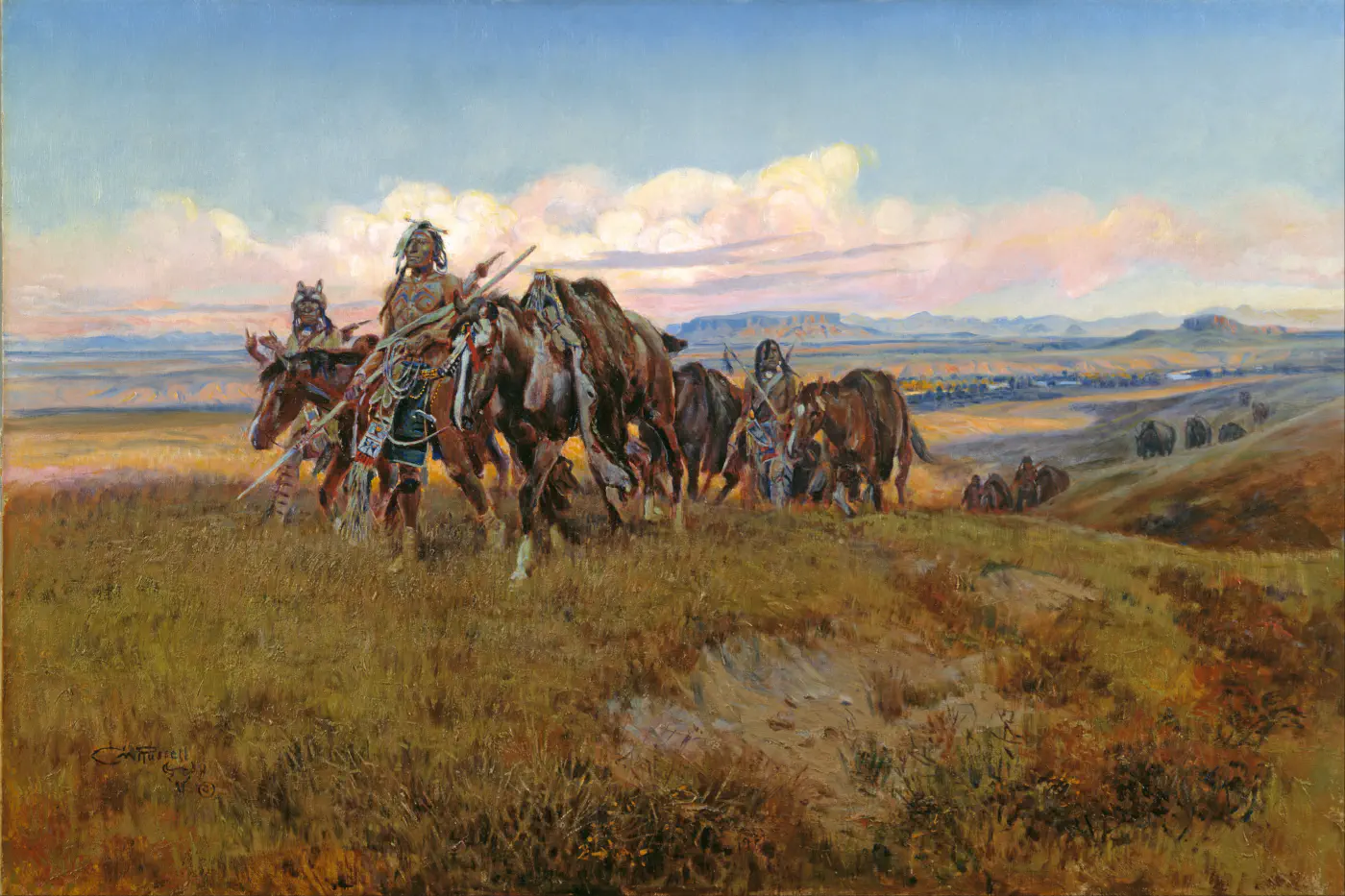
The imagery in this book is just stunning. McCarthy’s narrative voice is biblical, and he makes the American West feel like a character in its own right. The landscape is sometimes beautiful and sometimes treacherous, but mostly it seems indifferent. Against its vastness, the people travelling through it feel small and insignificant.
They watched storms out there so distant they could not be heard, the silent lightning flaring sheetwise and the thin black spine of the mountain chain fluttering and sucked away again in the dark. They saw wild horses racing on the plain, pounding their shadows down the night and leaving in the moonlight a vaporous dust like the palest stain of their passing.
We rarely get to peer into those people’s minds or hear them explain their motivations. I didn’t feel that the book needed much of this, given how I read its treatment of violence: as something innate in humankind, which does not always have a reason that makes sense. Even so, I never felt that characters such as Glanton were undeveloped. His belief that he is being pulled along by fate gives us a glimpse of how he understands his life. To me, his acceptance of his death follows from that belief.
In between glimpses of the beautiful landscape, McCarthy depicts acts of extraordinary violence. Nobody is spared, even animals and infants. At times this bordered on gratuitous for me, particularly in the middle section, where the pattern began to feel repetitive: travel somewhere else, murder, rape and pillage another group of people, then move on. I understood that violence was central to the book, but I still felt that this section could have been shorter.
Despite being repulsed by him, I found myself enthralled whenever Judge Holden spoke. I am not exaggerating when I say that he is one of the most gripping characters I have ever read about. Bald, enormous and toweringly tall, he is an imposing presence even before he opens his mouth. His knowledge and intellect give him another means of exerting power over the people around him.
I feel like I would need to reread this book many times to understand the full depth of Holden’s philosophy. As I understand it, he believes that war is the fundamental law of the universe: it existed before humankind and will exist afterwards.
And the answer, said the judge. If God meant to interfere in the degeneracy of mankind would he not have done so by now? Wolves cull themselves, man. What other creature could? And is the race of man not more predacious yet? The way of the world is to bloom and to flower and die but in the affairs of men there is no waning and the noon of his expression signals the onset of night. His spirit is exhausted at the peak of its achievement. His meridian is at once his darkening and the evening of his day.
What interests me is whether the world around him actually supports his philosophy. I am not sure that the landscape’s indifference does. It seems to me that the Judge imposes his own meaning on the world to help him make sense of it, and above all to control it. He records things in his ledger and then destroys them, as though knowing about something is insufficient unless he can also possess it. His statement that “whatever exists without my knowledge exists without my consent” captures that need for control.
The Kid complicates the Judge’s view of the world. He is violent himself and participates in the gang’s atrocities, but I never felt that the Judge entirely succeeds in winning him over. To me, his resistance suggests that people still have some capacity to choose their own path, however much violence has shaped their lives. However, I would argue that he is complicit in the actions of the gang. It is only towards the end of the book where his actions begin to diverge from the others. Perhaps there is a kind of mob mentality going on, where each member of the group feels they must partake in the violence, for fear of retribution if they go against it. His attempts to connect with other people also made him more sympathetic to me. The scene where he speaks to an old woman, only to discover that she is a corpse, is particularly sad. In a book where people so often treat one another with extraordinary cruelty, that unanswered attempt at connection stayed with me.
What Stayed With Me
Spoilers for the ending follow.
I had begun to wonder how the seemingly endless violence could lead to a satisfying ending, but McCarthuy manages to stick the landing.
I wanted the Kid to escape the Judge, which made their final encounter all the more disturbing. I read it as the Judge ultimately winning, killing the Kid or somehow “absorbing” him. What makes it so horrifying is McCarthy’s refusal to describe exactly what happens. After a whole book of explicit brutality, he leaves this act out of view. To me, that omission suggests something more depraved than even the violence we have already witnessed.
It is the Judge’s philosophy and McCarthy’s imagery that have stayed with me most. I still have questions about the Judge’s view of the world, and about how far the novel asks us to accept it. Those questions are a large part of what made the book so rewarding, despite the stretches I found exhausting. I finished it feeling that I would need to read it again.
Get the next review straight to your inbox.
Get an email whenever I publish something new. Subscribing is free and you can cancel at any time.