High-Rise
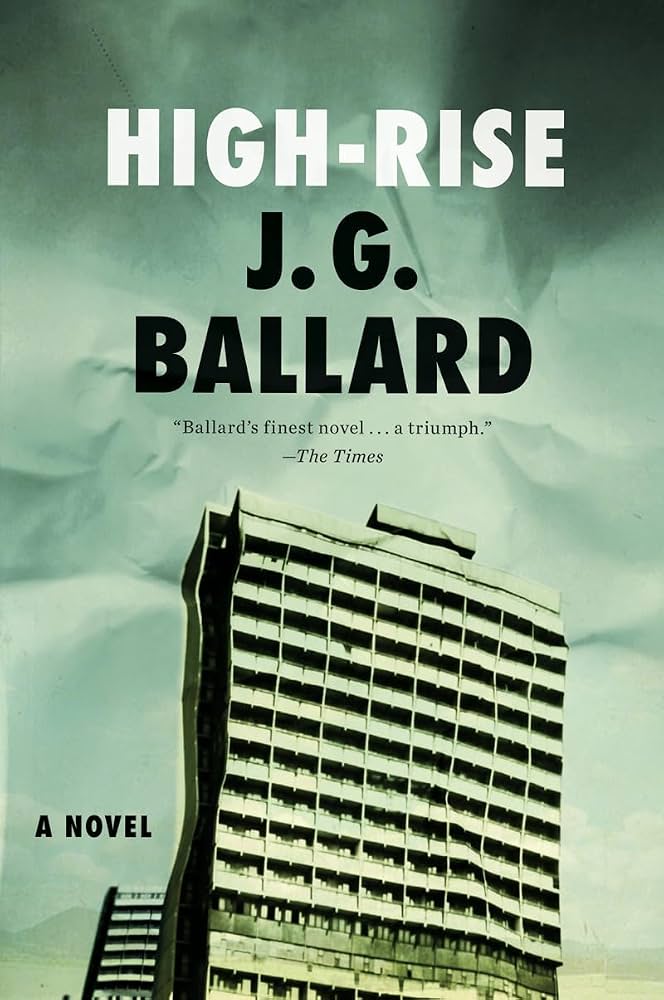
A dark satire about a luxury tower block whose middle-class residents willingly descend into violence, tribalism, and chaos.
Later, as he sat on the balcony eating the dog, Dr. Robert Laing reflected on the unusual events that had taken place within this apartment building during the previous three months.
So begins J.G. Ballard’s 1975 novel High-Rise. The premise of High-Rise can be summed up as: in a forty-storey East London tower block, aimed at middle-class professionals, the residents of the block turn to degeneracy in a way that is reminiscent of Lord of the Flies. Degeneracy is definitely the right word: there are beatings, killings, and even suggestions of cannibalism.
My first exposure to J.G. Ballard’s work was when a friend handed me a copy of his 1973 novel Crash, a novel which centres around a group of sexual deviants who eroticise automobile accidents and take pleasure in recreating and getting off to them.
So why was I then surprised when it turned out that High-Rise was also a novel full of degeneracy? It was as if I couldn’t imagine Ballard reaching the same heights.
My edition of the novel contained an interview with Ballard at the end of it. In it, I learned that he was born to British parents in Shanghai, and that at the outset of Imperial Japan’s involvement in the Second World War, he and his family were detained and sent to an internment camp. Knowing this, it is clear to see the influence this experience had on the novel, which centres on themes of isolation, brutality, and societal collapse.
Our protagonist, Robert Laing, is one of over 2,000 professionals living in this “vertical city”, an ultra-modern (even by our standards) apartment block which contains multiple swimming pools, a rooftop terrace, and even a supermarket and liquor store.
But contrasted with this degeneracy is a strange order, as a hierarchy breaks out between the residents: the relatively poorer residents of the bottom floors, the aspiring elites in the middle, and the true upper class on the higher floors. Yes, it’s pretty heavy-handed imagery, you might be thinking: it’s not a very subtle book. A subplot in the book concerns a filmmaker, Wilder, who lives on the bottom floor of the tower, and his gruelling ascent to the top floor, which sees him commit multiple barbaric acts to get there.
It’s an extreme piece of writing which I don’t see as a realistic account, but rather as an exploration of some fears of the time: how one’s environment can shape their behaviour, and also a challenge to our ideas of civility and justice. How civil and just will one act when there is no incentive to do so?
Ballard suggests the answer to that question is: not very. He posits that the residents of the block actually enjoy the violence to the point where they choose to stay living in these conditions rather than leave, and refuse to get the police to investigate, even when there have been brutal raids on apartments, assaults, rapes, and even the eating of pets.
I’m not quite sure I believe that people would want to hurt each other just for the sake of violence, and I’m not sure we would want to do so more just because we are arranged in a tower block. Yet Ballard envisions the tower as a liminal space where one can enjoy taking part in depraved acts, safe in the knowledge that they will have no impact on one’s professional life.
In this way, Ballard is not suggesting that this would happen, but merely that it could happen. I’m not sure I can see what that says about Ballard’s morality, but perhaps that was not the intention. An interview included in my edition ends up providing perhaps the best answer:
Do you think there is a moral purpose to your fiction?
“I am not sure about that. I see myself more as a kind of investigator, a scout who is sent on ahead to see if the water is drinkable or not.”
— J.G. Ballard, in interview
Enjoyed this post? Subscribe to make sure you never miss a review.