The Corrections
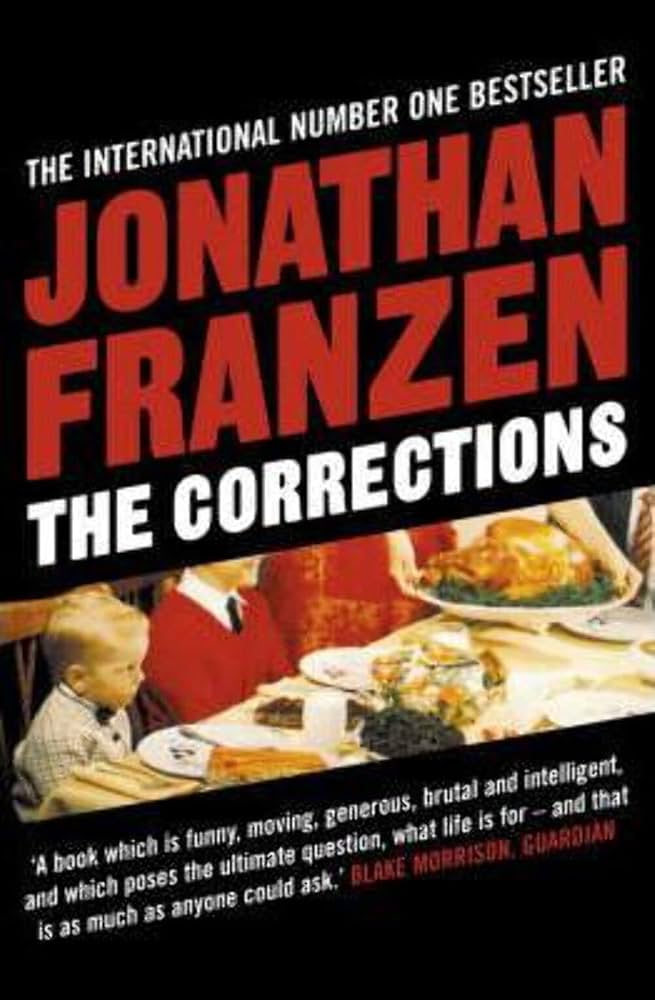
A sharp, character-driven novel about a family attempting to correct the wounds of their upbringing, only to discover how stubborn those patterns really are.
What struck me most about The Corrections is how each member of the dysfunctional, middle class Lambert family believes they are the only reasonable one. Alfred, the patriarch, is suffering from Parkinson’s disease. His wife, Enid, who is struggling to look after the ailing Alfred, wants to get the whole family back together to the fictional Midwestern hometown of St. Jude for “one last Christmas”.
As we learn more about the troubled lives of each of the family members, we learn why this is such a tall order. This is certainly a character driven novel, and Franzen produces a very detailed character study of Alfred, Enid and their 3 adult children, Gary, Chip and Denise. We learn about the many ways in which the dysfunctions of the parents cause their children to rebel and attempt to “correct” the perceived shortcomings in their parents’ relationships: Gary, the eldest son, is a high earner, is married with 3 children and makes his home in a big house in an affluent neighbourhood of Philadelphia, but wrestles with the lack of control he feels over Enid, his wife Charlotte, and his 3 children and siblings. Chip, disgraced after a workplace scandal, attempts to rebuild himself as a writer, but can never seem to focus on his manuscript. And the youngest daughter, Denise, gets in a string of several dysfunctional relationships of her own, choosing to bury herself in her career as a cook to cope with it all.
My favourite character to read about was Gary, who we meet early in the novel. The tragedy is that Gary, in vowing not to be like his father, ends up becoming a tyrant in his own family unit. His marriage to his wife Charlotte is described more like a proxy war than a loving relationship; and I feel like his character really epitomised what I felt was the key theme of the novel - about how we try to correct the things we feel wronged by in our lives, and how our efforts to do this are “corrected” by the markets of life.
I found Alfred’s character in particular to be very interesting. Initially, I found him a sympathetic character, if not stubborn; later, as we find out more about his life, and his treatment of Enid and his children, I felt he really was the antagonist, the one who set the entire chain of events we learn about in the novel into motion. However, as his condition deteriorates towards the end of the novel, I could not help but feel sorry for him. His eventual demise is presented as pathetic and degrading, and although it is probably no less than he deserves, I found it very moving to read about.
On the other hand, Chip’s episode in Lithuania verges on a caricature; initially it presented itself to me as satirical, but as we learn more about his exploits (defrauding Western investors, fleeing corrupt police in a car chase) I began to wonder whether it was in fact satirical, or whether I was reading an American’s opinion on what life in the Baltics must be like. However, it again illustrates the theme of how their corrections fail: Franzen uses Chip to demolish the idea that geography can fix character – how many times have we thought that we just need to move somewhere else and start again, in order to fix something wrong with us? In retrospect, I do feel like this could have been shorter; there are a couple of minor plot threads which don’t get fully resolved, and I think the book would have had the same impact even with these removed. The Corrections is not a short read at 568 pages, but at times it felt less like reading and more like watching the lives of the Lamberts unfold in front of me.
Despite these frustrations, I still thoroughly enjoyed this book. I tend to lean towards novels that are more plot driven, and The Corrections challenged me at times while reading it. In fact, it continues to as I write this review. But the more I think about it, the more I realise that is why it works. The Lamberts don’t change in the way we hoped, or they way we expected, and I think that’s the point of the book. Change, it suggests, is harder than we think, or perhaps hope, that it is.
Enjoyed this post? Subscribe to make sure you never miss a review.