Leaving the Atocha Station
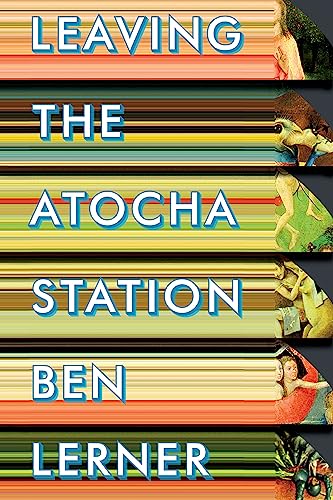
Perceptive, funny, and deeply entertaining. A highly impressive debut novel by Ben Lerner
As far as debut novels go, I think this may be one of the finest I have read. Not because of an intricate plot (in fact, there is very little plot in this book) but because Lerner makes us think about the uncomfortable gap between who we think we are and who we want other people to think we are.
The main character of the novel, Adam Gordon, is an American student studying in Madrid, having been awarded a prestigious fellowship. I felt like I was meant to hate Adam’s character. He is presented as an aloof, entitled liberal arts student on a grand tour of Europe. I have to say that I actually enjoyed reading about his routine, eating “hard bread and chorizo” in a café and then hopping over to the Museo del Prado or El Retiro. As the novel progresses we learn that Adam indeed hates himself, which strangely makes him more likeable to read about. In a way, it feels like Adam is partially redeemed to the audience because he recognises his own self hatred. His honesty with himself doesn’t excuse his behaviour, but it does make him surprisingly sympathetic. However, the closeness that Lerner has to his character (Lerner himself received a Fulbright scholarship and studied in Madrid in 2004) makes Adam’s relentless self analysis feel even more uncomfortable. It feels as if Lerner is turning the microscope on himself as much as he is on his protagonist.
A plate of steak tartare was brought to us and Isabel looked at it with muffled surprise and it was clear she had never imagined eating finely chopped raw beef… I served her a punishingly large portion and it was suddenly obvious, much more obvious than I intended, that my clothes and the expensive meal were saying to Isabel: of course I never took our relationship seriously; I am a fabulously wealthy American from the United States of Bush, I have merely been acquiring experience, slumming, etc.
The plot of the book is quite loose, but anchoring the narrative is the bombing of the Atocha station that took place in Madrid on the 11th of March 2004. Adam wants to shed his American identity, he wants to become a European intellectual, yet finds himself wondering if historic events are something he is able to participate in, or merely something that passes him by. He is forced to confront the fact that history doesn’t care how we choose to see ourselves.
One of the novel’s most interesting ideas concerns the relationship between language and reality. I enjoyed how Adam constructed his poetry, using homophones between English and Spanish to inspire him. It was interesting to see the creative process of a poet analysed like that. I always felt like writing poetry or song seemed like an act of inspiration, rather than a calculated act that requires close attention.
Over the course of the novel, Adam’s own understanding of Spanish gets better, although he frequently doesn’t catch some or all of what is said. This introduces an element of unreliability into the narrative that is enjoyable to try and pick apart: not because Adam is lying to us (although he might be), but because language itself becomes a sort of lens through which the reality of the novel is experienced.
It’s funny, it’s uncomfortable, and it’s perceptive. And of course, it’s deeply enjoyable. The writing reminded me somewhat of Jonathan Franzen. If you enjoyed The Corrections, I would certainly recommend this book to you.
Enjoyed this post? Subscribe to make sure you never miss a review.